Zennie62 on YouTube

Monday, March 20, 2006

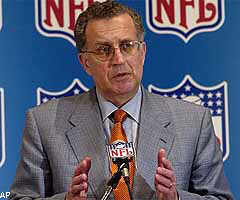
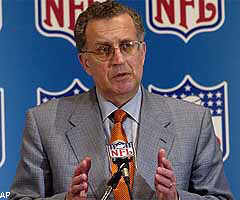
PAUL TAGLIABUE ANNOUNCES HIS RETIREMENT AS NFL COMMISSIONER


NATIONAL FOOTBALL LEAGUE
280 Park Avenue, New York, NY 10017
(212) 450-2000 * FAX (212) 681-7573
WWW.NFLMedia.com


Joe Browne, Executive Vice President-Communications
Greg Aiello, Vice President-Public Relations

FOR USE AS DESIRED
NFL-10 3/20/06

PAUL TAGLIABUE ANNOUNCES HIS RETIREMENT AS NFL COMMISSIONER

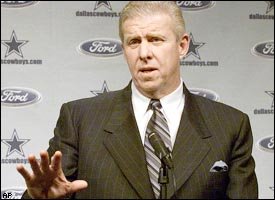
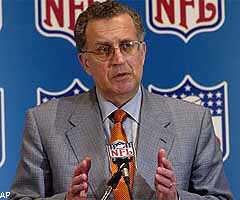
Commissioner PAUL TAGLIABUE is retiring at the end of July from the position that he has held since late 1989, the NFL announced today.

Tagliabue, 65, called Pittsburgh Steelers owner DAN ROONEY early this morning and told him of his decision. Rooney, the chairman of the ownership committee that negotiated Tagliabue’s last contract extension in 2004, notified all clubs by email at noon (ET).

“I believe that now is a positive time to make the transition to a new commissioner,” Tagliabue said. “We have a collective bargaining extension in place, long-term television contracts, and have undertaken many other strong elements in league and club operations. I am honored to have been commissioner since late 1989 and to have been heavily involved with the league, its owners, clubs, coaches, players, fans and media since 1969.”

NFL owners will begin formal discussions of transition planning and the search for a new commissioner at the NFL Annual Meeting, which begins March 26 in Orlando, Florida.

As part of his contract with the league, Tagliabue will be available to serve in a senior executive/advisory role through May 31, 2008 once a new commissioner is selected.

Under Tagliabue’s leadership, the NFL has grown from 28 to 32 teams, revised its divisional alignment and scheduling formula, operated under successive long-term labor agreements with the NFL Players Association, and maintained its preeminent position in sports television.

During this time, the NFL also has expanded league and team commitments to community service, refocused the NFL’s efforts in developing public-private partnerships for new stadiums, and expanded its international appeal and presence.
In addition, the NFL under Tagliabue has been the new media leader in sports, creating the first leaguewide Internet network for fans and first satellite television subscription service, and launching the NFL Network on cable and satellite television.
Before succeeding the late PETE ROZELLE as the league’s CEO on October 26, 1989, Tagliabue represented the NFL as an attorney in many important areas as a partner at Covington & Burling, a Washington, D.C., law firm, the NFL’s principal outside counsel.
# # #

Sunday, March 19, 2006

The Terrell Owens - Dallas Cowboys Deal; Where's Bill Parcells


There are some sources -- check Pro Football Talk at www.profootballtalk.com -- who believe that the deal to bring Terrell Owens to the Dallas Cowboys was not approved of by Head Coach Bill Parcells.

But of all of these comments I found at the Dallas Cowboys website, the one by Quarterback Drew Bledsoe seems to indicate that Parcells did back the deal. Read on:


IRVING, Texas - The Cowboys' signing of Terrell Owens is undoubtedly one of the biggest NFL stories in recent history.

So here is what they're saying about Owens suddenly becoming a Dallas Cowboy:

Former San Francisco quarterback Jeff Garcia, who once played with Owens, took the high road this week after signing with Philadelphia when asked about the outspoken wide receiver who trashed him before getting traded: "I don't have a problem with the guy. The guy is a tremendous player on the field."

Former Cowboys tight end James Whalen, who spent training camp with the Eagles in 2005: "In my opinion, he's the best player in the NFL. To me, his biggest problem in Philadelphia was that he felt he was owed more money. And Philly wasn't willing to compromise. But I think it can work (in Dallas). If he's happy with his contract, I don't think he's going to be a problem."

Former Cowboys safety George Teague, who decked the celebrating Owens at the 50-yard line during a 2000 regular-season game: "I'm still in a little disbelief. But I know Jerry Jones and I know we want to win football. But for me personally, it's a little disappointing after how his actions a couple of years ago . . . I don't see how anyone can forget."

Cowboys owner and general manager Jerry Jones on the contract given to Owens: "We can both disappoint each other in this agreement. But this is no free lunch to the Dallas Cowboys. We made a commitment to him. That means something."

Terrell Owens when asked about the 2000 incident when he twice celebrated on the 50-yard line star at Texas Stadium: "No disrespect. I am a competitor. I wanted to win. Just as Emmitt [Smith] did when he stood in the star, I am going to embrace it from here on out."

Cowboys quarterback Drew Bledsoe when asked if he was surprised that Bill Parcells would want to sign Owens: "It doesn't surprise me at all. Bill wants to win, just like I do, just like Jerry does, just like all of us. And if there's a chance to make us better, then it doesn't surprise me one bit that he would sign off on this."

Former Cowboys wide receiver Michael Irvin, a good friend of Owens: "In order for the Cowboys to get where they need to get, they need a pure No. 1 receiver, and that's what this guy is. When Drew drops back three, five and seven (yards), he will get open. And the times he's not open, throw it anyway because he can still get it."

Saturday, March 18, 2006

T.O. to The Dallas Cowboys - An "In Your Face" To The Eagles


This is tbe best deal of its kind since free agency was established in the NFL. The kind of deal one always feared. The one that sends a disgruntled, unwanted, but very, very good player to a rival organization.

That deal just happened as Terrell Owens signs a three year contract with The Dallas Cowboys-- read below.


Owens joins Cowboys, signs three-year deal
NFL.com wire reports
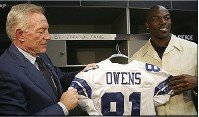
IRVING, Texas (March 18, 2006) -- Terrell Owens has gone from stomping on the Dallas Cowboys' star logo to wearing it on his helmet.

The reviled receiver joined the Cowboys, signing a contract to play for Jerry Jones and Bill Parcells in what promises to be an interesting combination of strong personalities.

There's no questioning his talent -- Owens has consistently put up numbers the Cowboys have lacked since Michael Irvin was in the prime of his career a decade ago.

It's his attitude that prompted the San Francisco 49ers and Philadelphia Eagles to get rid of Owens. His relationship with the Eagles soured only months after he led them to the Super Bowl, finally ending with his release March 14.

Details of his contract weren't immediately available, but it was likely to include behavior-related provisions. His blowup with Philadelphia last season even led to new rules regarding punishment being written into the NFL's latest collective-bargaining agreement.

Jones, who built a billion-dollar fortune by taking big risks, is willing to take this one because the Cowboys have gone nine years without winning a playoff game.

Part of the gamble is that fans will warm up to Owens, who launched his flamboyant persona in September 2000 when as a member of the 49ers he celebrated each of two touchdown catches at Texas Stadium by running to the team's star logo at midfield. Safety George Teague secured a spot in team lore by decking Owens after the second one.

On a Monday night game in 2004 best remembered for his pregame skit with a Desperate Housewives actress, Owens celebrated another score by tapping on a logo in the end zone.

Until his behavior limited him to nine games last season, Owens had at least 75 receptions and 1,100 yards receiving in five consecutive seasons. The last time a Cowboys receiver hit both figures in one season was Irvin in 1997.

But Owens also has alienated teammates, coaches and the front office with the things he says and does.

In Dallas, Owens joins a team coming off a 9-7 season that included a 2-4 finish, keeping them from making the playoffs for a second successive season. The Cowboys seem to need more than a star receiver to get over the hump, but do need a main threat after releasing Keyshawn Johnson on March 14.

The team lacks veteran leaders, with captains Dan Campbell and Dat Nguyen already gone, as is La'Roi Glover, another calming influence. Dallas also is in a tough division that includes T.O.-less Philadelphia, the New York Giants hoping to improve as quarterback Eli Manning develops and the Washington Redskins, who have been big spenders in free agency.

The Eagles gave up on Owens only months after he helped them reach the Super Bowl. He demanded a new contract one year into a seven-year deal, then squabbled with quarterback Donovan McNabb.

Before that, Owens forced his way out of San Francisco with repeated hijinks on the field and through disparaging comments about teammates, including quarterback Jeff Garcia.

Jones is no stranger to unpopular moves.

After winning big gambles in real estate and digging for oil wells, he put it all on the line to buy the Cowboys in 1989. Since then, he has fired Tom Landry, forced out Jimmy Johnson, entrusted a championship club to Barry Switzer and given Deion Sanders a $13 million signing bonus.

Jones felt pretty good about his choices when the Cowboys won their third Super Bowl in a four-year span. But that was 1995; Dallas has won only one playoff game since.

He has lost other big gambles along the way, from sticking with Switzer to hiring Chan Gailey, then Dave Campo as head coaches. He also has risked public scorn by releasing franchise icons Troy Aikman and Emmitt Smith.

Irvin's off-field woes are the local precedent for taking on Owens. However, while Irvin might have tarnished the team's image, he was a devoted teammate and fan favorite.

When Irvin was returning from a five-game suspension in 1996, he was asked how he expected fans to treat him. Irvin said he only had to score a touchdown to win them back -- and he was right.

Could it be that easy for Owens?


AP NEWS
The Associated Press News Service

Wednesday, March 15, 2006

Pats Cut Wille McGinest; Browns Pick Him Up


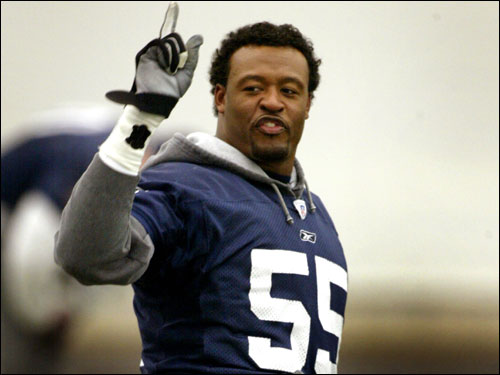
Pats Lineman and USC Trojan Willie McGinest was reunited with his old defensive coach Romeo Crenel today. It's a great move for the Browns as he knows the defense the Browns run -- it was the same as that he played within in New England. The Pats, on the other hand, lose a great team leader.

The Browns are on a serious free agency tear. They've got DT Ted Washington, WR Joe Juervicious, to name some of the more famous names. Let's see how this impacts their draft postion. Will they trade down?

Sports Illustrated's Mike Silver Sheds Light on The Edgerrin James Deal Sending Him to Arizona

Mike Silver's got a knack for getting to the real story behind NFL players. He does that here with Edgerrin James, the former Indy Colt who's now running back for the Arizona Cardinals.

But knowing Mike, he may have even hit a bar in South Beach while on the story! (Click on this post's title to read it.)

Tuesday, March 14, 2006

NFL Free Agency Roundup

Man. Gone a few days and the NFL turns upside down. To find out who-went-where at a glance, I went to NFL.com. This is what I learned:

Mike Anderson signed with Baltimore away from Denver.

Egderin James is now with the Arizona Cardinals! (I guess he doesn't want a Super Bowl ring after all!)

John Kitna bolted Cincinnati for The Detroit Lions, leaving the Bengals in the hunt for a quaterback to spell the healing Carson Palmer.

The Bengals signed Super Bowl XXXIV MVP Defensive Back Dexter Jackson away from the Tampa Bay Bucs.

Drew Brees is now a New Orleans Saint, which eliminates their need to draft a quarterback.

The Oakland Raiders have done nothing on the free agency market -- yet.

Thursday, March 09, 2006

Patriots cut LB McGinest after 12 seasons

NFL.com wire reports

FOXBOROUGH, Mass. (March 9, 2006) -- The New England Patriots released linebacker Willie McGinest in a salary-cap move, ending a 12-year relationship with the NFL's all-time postseason sack leader.

The release of the two-time Pro Bowler was announced March 9, the day after the NFL owners voted 30-2 at their meeting in Grapevine, Texas, to extend the collective bargaining agreement with the players for six more years, resulting in a new salary cap figure of $102 million.

The 34-year-old McGinest carried a salary cap figure of more than $7 million for next season. The veteran linebacker is now a free agent and can sign with any team, including New England.

NFL Adopts "Baseball Style" Revenue Sharing Adjustment - Observation

The new NFL CBA includes and adjustment where the richest revenue teams place a portion of their revenues into a pool which is then used by the smaller revenue organizations. This is very much like the system in the current Major League Baseball Collective Bargaining Agreement, but the percentage of the top-tier-teams revenue gotten is not as great.

Commissioner Tagliabue Press Conference, Special League Meeting, Dallas Texas, March 8, 2006


This from NFL Media.com today

Commissioner Tagliabue:

We just concluded two long days of meetings. Last night we went until about 1 a.m., and this morning we started around 7 a.m. and finished at about 6:59 and 59 seconds before the 7 p.m. deadline. The membership approved the Collective Bargaining Agreement and accepted the offer of the Players Association for the six-year extension of the Collective
Bargaining Agreement by a vote of 30 in favor and two voting against.

It was really a tremendous effort by owners across the entire spectrum of the league, no matter how you define the spectrum – whether it's in terms of longevity, whether it's in terms of big-market, small-market or high-revenue, low-revenue. Everyone came together after these two full days of discussions and reached a consensus not only on the Collective Bargaining Agreement, but on some major new revenue-sharing features to support the ability of all teams to function well under the Collective Bargaining Agreement.

The consensus was forged really by all 32, but nine teams worked this afternoon to take two different concepts that had evolved over the last two days and meld it into one concept. The first concept had been developed in the last two days by the New York Jets and the New England Patriots, Woody Johnson and Jonathan Kraft. The second concept had been developed by the Pittsburgh Steelers and the Baltimore Ravens, particularly Art Rooney and Ravens President Dick Cass. Then over the luncheon hour, three other owners spoke with me about a concept for putting together the two proposals, the two
different sets of ideas, and a process to take the Jets-Patriots concept and the Ravens-Steelers concept and blend it into one.

Those three owners were John Mara, Jerry Richardson and Pat Bowlen. Then when we resumed this afternoon, all of those owners plus Jerry Jones and Arthur Blank played a critical role. We ended up with one single resolution that brought all of the different ideas together. It was sponsored by the nine teams that I just mentioned: Giants, Steelers, Patriots, Ravens, Falcons, Panthers, Broncos, Jets and Cowboys. And that's what we presented to the membership and explained it. Once it was all explained, we had the vote and it was adopted without any changes. The blending of the two proposals into one, which was developed this afternoon between 3:15 and 6 p.m., was accepted on the basis that it was presented and developed by those nine teams. In addition to Art Rooney, Dan Rooney was involved in that process. In addition to Arthur Blank, Rich McKay was involved in that process, plus all the owners I've already mentioned. I'll be glad to take questions.

Q: Can you discuss the new revenue sharing agreement?

PT: The revenue sharing basically is a commitment of almost $500 million over the first four years of the deal and then several hundred million additional dollars over the last two years of the deal. I think the total amount over the life of the deal gets to over $850 or $900 million of incremental revenue sharing to be funded in some significant degree by the high-revenue clubs. "High-revenue" includes the top five, the next group, six through 10, and to a lesser degree the clubs who rank 11 through 15. All of those clubs in differing proportions ended up making the alliance or the commitment to fund the
revenue sharing.

Q: How will those funds be redistributed among the membership?

PT: The lower-revenue teams will draw from that fund. The overall concept was geared to the idea that when a team spends to the midpoint between the salary cap and cash over the cap on an average basis, to spend to that level a team should not have to spend more than a specified percentage of its own revenue. So there is an objective standard in there.

Q: What number, percentage-wise, is fair or equitable?

PT: The target in this concept was 65 percent maximum, as a percentage of your own revenues. Of course, the players are getting an unprecedented high level of total revenue, approaching 60 percent of the total.

Q: What will the salary cap be for the 2006 season?

PT: The salary cap for 2006 will $102 million and for 2007 be $109 million.

Q: When will the free agency period begin?

PT: Free agency is going to begin after a 48-hour hiatus, so that clubs can use the additional funding within this cap to re-sign players rather than release players, if that's the way they choose to proceed.

Q: Can you describe some of the other landmark changes that are included in this new CBA?

PT: There are several major features, a lot of major features. There is a significantly expanded post-career medical coverage for players. They already have five years postcareer. There is a healthcare-IRA-type element set aside that the players will get funded in proportion to the length of their career. It's quite a significant improvement in benefits.

The franchise player rules basically stay as they are with some minor tweaking. For the first time a player is tagged and the second time a player is tagged, then in the eventuality, which is very rare, that a player would be tagged a third time, the structure has been modified so as to virtually ensure that in the future there would not be any three time tags, that players and clubs would be able to work out multi-year agreements, including signing bonuses, either the first time a player was tagged or the second time a player was tagged.

Another change is that drafted players in rounds two through seven will have a maximum contract length of four years. Someclubs have been signing players to five and six-year contracts. That had become an issue with the Players Association in this negotiation relative to the concept of free agency after four years. We agreed there would be a maximum contract length of four years for players drafted in rounds two through seven. The first round can still be negotiated with longer deals.

Q: Any changes in terms of club disciplinary procedures and forfeiting signing bonus?

PT: Yes. There are also provisions in there that modify the ground rules in terms of forfeiture of signing bonuses. There are also a number of areas that the discipline provided at the league level for the most part becomes the exclusive form of discipline, whether its suspension or fines, such as with the drug program and with other areas. League discipline would become exclusive.

Q: Any changes in the amount of the rookie salary pool?

PT: No. We had a lot of discussions about the rookie pool, but in the end I don't think we've made any changes.

Q: On the discipline aspect, you're saying that what Philadelphia did to Terrell Owens could no longer be an option?

PT: I'm not saying that. I'm saying that in certain areas we've modified what teams can negotiate. In certain other areas, we agreed that league discipline would be exclusive and that individual club contracts would not be individually negotiated departures from the league disciplinary pattern. That would not be permitted.

Q: You've said all along that this would get done at the 11th hour and 59th minute. It almost sounds like it was orchestrated.

PT: Do you have another question? Harold Henderson heads our Management Council and he had been hearing me say for several years that this would get done at the 11th hour and 59th minute. Frequently over dinner he'd say, "11th hour and 59th minute before what?" And I would say, "I don't know. It's just going to be at the 11th hour and the 59th minute."

Then the other night on Sunday when we had the second break off of negotiations and we were able to talk to Gene Upshaw late at night that his proposal would be presented, I think we got it done after 11 p.m. Then Harold finally said to me, "Now I know what you mean when you talk about the 11th hour and the 59th minute. We're now at the 11th hour and the 24th minute." So I say, "Wait until we get to Dallas. If we have more than 60 seconds to spare, it will be a miracle." And that's the way it turned out.

Q: How important is this new agreement to game of football and the league?

PT: I think it is important. Time will tell how important it is, but it was certainly an opportunity to continue building what we've been building. I think it's great for the fans. I think the quality of the game is at a tremendous level. The spread of talent around the league, the ability of teams to become competitive relatively quickly and to do what Marvin Lewis has done and what other coaches have done, it's a great thing. This preserves all of that. It continues with the elements that we have with the Players Association on the shared cost of constructing new stadiums. It continues a lot of our initiatives, Youth Football and other areas. So I think it's a very positive thing for the fans and the league generally even though it's a stretch from a financial standpoint for many, many teams in terms of the cost.

Q: Does this agreement affect the G-3 funding program for new stadiums?

PT: There are some changes in the G-3 funding program, yes. Basically it's an improvement.

Q: Are debts of some of the high-revenue teams addressed in this agreement?

PT: Not in any way that I could explain right now. We didn't get to the point of micromanaging the way teams operate. We set targets in terms of what should be a reasonable target that a club would have to spend on players to be competitive relative to its own revenues. Once we had that target agreed to, then we did a calculation, or thousands of calculations. Once you translated that target and tried to figure out how it would play out over the next six seasons, the question was, "What is the resulting revenue-sharing obligation that had to be funded?"

And that is what we funded. But we didn't get into micromanaging what teams do in order to generate revenue or to
figure out how to net out the costs of stadium construction, except in some of the structural elements of the agreement. There is a concept of TFR, which takes account of stadium construction costs, there's a G-3 credit that takes account of that, but we didn't micromanage what teams do. We want to have the right incentives for teams at every level, the right support through the league and to give great incentives for low-revenue teams to pick their revenue up, be it through new stadiums or other things. But it's not micromanaging.

Q: Beforehand, you had thought that revenue sharing did not necessarily have to be a part of this deal, but it is now part of the package. Can you discuss that?

PT: I always thought it would be part of the package. That was always my expectation.

Q: How pleased are you that this is done?

PT: I'm pleased, and more than pleased, I'm relieved.
###
Wednesday, March 08, 2006

NFL and Players Union Reach Agreement

And Raiders QB Kerry Collins remains with the Silver and Black. We''ll find out who's going where starting Friday.

NFL.com wire reports

GRAPEVINE, Texas (March 8, 2006) -- Labor peace was restored to the NFL when the owners agreed to the players union's proposal, extending the collective bargaining agreement for six years.

There were no further details on the agreement, or whether it includes expanded revenue sharing.

The vote was 30-2, with Buffalo and Cincinnati, two low-revenue teams, voting against the extension.

Free agency, put off twice by the protracted negotiations between the owners and players, now will start at 12:01 a.m. March 10.

"It was a good compromise," said Jim Irsay, owner of low-revenue Indianapolis. "We're happy with it -- 30-2 is a good vote."

The agreement comes after a week of on-again, off-again negotiations, culminating in a two-day owners meeting.

No agreement wouldn't have meant a work stoppage -- at least not for the next two years -- but it would have sent teams scrambling to get under a $94.5 million salary cap. That would have put a number of veterans on the street and it would've also limited the amount of money available for other free agents. And it would've led to an uncapped year in 2007.

Now the cap is expected to go up by as much as $10 million with an extension of the CBA in place.

The real debate was between the owners themselves on the important issue of expanded revenue sharing.

The revenue debate involves low-income teams such as Buffalo, Cincinnati and Indianapolis who say high-revenue teams -- Dallas, Washington and Philadelphia, for instance -- should contribute proportionately to the player pool because they can earn far more in nonfootball income such as advertising and local radio rights.

Those high-revenue teams might contribute only 10 percent of their outside money compared with 50 percent or more for low-revenue teams.

"Some teams are contributing a little more than others," Redskins owner Dan Synder said. "This is really a win-win."

Gene Upshaw, the executive director of the NFL Players Association, has insisted throughout more than a year of negotiations that the division between owners must be resolved before agreement could be reached on a contract extension.

Houston Texans Sign G Steve Mc Kinney and Plan To Go After Rams Isaac Bruce

This is from the Houston Chronicle's John Mc Clain. It also explains that The Texans will use the same zone blocking system that Denver used.

Here's the article, in case the Chron fails to maintain the link:


Although the start of free agency has been delayed a second time as owners and the NFL Players Association try to extend the collective bargaining agreement, it has not kept the Texans from doing business.

Although the Texans had no problem getting under the $94.5 million salary cap, general manager Charley Casserly will enter free agency with more revenue to spend because of the cap dollars freed up Tuesday by guard Steve McKinney's deal.

McKinney agreed on a four-year extension worth $9 million, including a $2 million bonus. It saves the Texans $2.2 million.

Meanwhile, the Texans are one of many teams interested in former St. Louis receiver Isaac Bruce, who was waived by the Rams when he declined to take a pay cut.

Although the Rams are hoping to re-sign Bruce, 33, he's going to test the market once the NFL allows free agency.

Because Jabar Gaffney and Corey Bradford will be unrestricted free agents, receiver is one of the Texans' priority positions this offseason. Without an extension of the CBA that would increase the salary cap at least another $10 million, it might be a long shot for the Texans to sign Bruce, who was limited to 36 catches for 525 yards and three touchdowns last season.

If the owners, who are meeting in a Dallas suburb, reject the union's latest proposal today, free agency will begin and teams can start bringing in players on Thursday.

Casserly and coach Gary Kubiak will be looking for help at receiver, tight end, defensive end, offensive line and linebacker.

The Texans tore up the last year of the five-year contract McKinney signed when he left Indianapolis for Houston in 2002 and gave him a new four-year deal. He was scheduled to make a base salary of almost $4 million.

"I was happy to do it, and it worked out to where it was fair to both sides," McKinney said. "I'm glad it's over so I can concentrate on football. I'm excited about our new coaches, and I'm fired up to start playing again and helping this team make the playoffs."

McKinney has two new offensive line coaches in Mike Sherman and John Benton. The Texans will play the same zone blocking scheme that Denver has made successful.

"I can't tell you how much it means to a new staff to have a veteran like Steve," coach Gary Kubiak said. "He was very unselfish last season when he moved from center to guard. We watched film of every play last season, and he just played so darn hard on all of them. Steve means a lot to what we hope to accomplish this season."

NFL Considering Union's Revenue Sharing Proposal In Dallas Now

After what was reported by ESPN's John Clayton to be a stirring speech by NFL Commissioner Paul Tagliabue, the NFL's 32 owners are discussing the revenue sharing proposal presented by NFL PA Exec Director Gene Upshaw. The deadline for a deal is today.

More later.

Visit the new Zennie62.com

Zennie62 blog net

 
Google Analytics Alternative