The NFL reset its deadline for Thursday at 12 Midnight, givjng teams more time to work through contract restructuring and more time for the league to get it's CBA house in order.
The Rams released WR Isaac Bruce while the Raiders still held on the QB Kerry Collins. I think both teams will have their vets back if the CBA matter is cleared.
Monday, March 06, 2006


Matt Birk: Matt Fires Off on NFL PA's Upshaw, But Makes No Sense In The Process
The "rant" he went on was just that, because Matt didn't explain exactly what Gene was doing wrong. Note to Matt: when you take time to call someone a name over the way they do a job, at least provide a detailed alternative approach. Or if you're trying to say "everything's fine" then say that, but it reads as if you're saying two messages at once: everything's fine and nothing's fine. Makes no sense to me.
But this rant is also a warning to Gene. It may be a style issue. If Gene is perceived as letting his ego get in the way of player's needs and is not appropriately accessible, it could cost him in the future.
Vikings' Birk rips NFL union boss Upshaw
‘What's going on right now is hurting all of us,’ says former Pro Bowler
NBCSports.com news services
Updated: 6:59 p.m. ET March 3, 2006
Minnesota Vikings center Matt Birk is not happy with the job being done by Gene Upshaw, executive director of the NFL Players' Association. Not at all.
Birk sounded off to columnist Mark Craig in Friday's edition of the Minnesota Star-Tribune.
"Don't put this in the paper ... no, wait, go ahead and put it in," Birk told Craig. "Gene Upshaw is a piece of (expletive). Too many guys in the league just accept whatever Gene says. I don't know why no one has called this guy out."
The former Pro Bowler believes the recent breakdown in negotiations between the NFL and the players' union is hurting the sport.
"It's a joke, it really is," Birk said in the paper. "Everyone is making money. A lot of money. You think anyone wants to hear about the money problems of the NFL owners or players? It's bad pub for the league. It's bad for all of us."
Birk, a Harvard graduate, says the prospects of a uncapped season -- something that could happen if a deal is not struck before the end of this weekend -- aren't good for everyone.
"When you go to those CBA meetings, you always feel like you're being sold something instead of being given the straight facts," Birk told the paper. "Through all the meetings leading up to this, it was always: 'The owners don't want an uncapped year. We'll get a deal, and if we don't, so what? There will be an uncapped year and there will be crazy money out there.'
"The reality is that's not the case. And you're seeing that it's not the leverage we were told it would be."
If there is no deal and the cap doesn’t increase, it would leave a glut of players on the free-agent market and many teams without much money to sign them. Next year, the final season of the contract, would be without a cap — and that would contain limitations that could hurt the players, such as raising the number of years of eligibility for free agency from four to six.
"And we'll lose some of our 401(k) and annuities, and some benefits, too," Birk said. "That's a huge deal to the younger guys making the minimum who might not have 10-year careers. Those are guys the union needs to look out for.
On the surface, the dispute is over percentage points -- the union says it wants 60-plus percent of league revenues earmarked for the players; the owners are offering 56.2 percent. That amounts to approximately $10 million per team per year.
"Gene thinks we're making all this money because of Gene Upshaw," Birk told the paper. "No, we're making all of this money because of TV. This sport is huge, and what's going on right now is hurting all of us."
But this rant is also a warning to Gene. It may be a style issue. If Gene is perceived as letting his ego get in the way of player's needs and is not appropriately accessible, it could cost him in the future.
Vikings' Birk rips NFL union boss Upshaw
‘What's going on right now is hurting all of us,’ says former Pro Bowler
NBCSports.com news services
Updated: 6:59 p.m. ET March 3, 2006
Minnesota Vikings center Matt Birk is not happy with the job being done by Gene Upshaw, executive director of the NFL Players' Association. Not at all.
Birk sounded off to columnist Mark Craig in Friday's edition of the Minnesota Star-Tribune.
"Don't put this in the paper ... no, wait, go ahead and put it in," Birk told Craig. "Gene Upshaw is a piece of (expletive). Too many guys in the league just accept whatever Gene says. I don't know why no one has called this guy out."
The former Pro Bowler believes the recent breakdown in negotiations between the NFL and the players' union is hurting the sport.
"It's a joke, it really is," Birk said in the paper. "Everyone is making money. A lot of money. You think anyone wants to hear about the money problems of the NFL owners or players? It's bad pub for the league. It's bad for all of us."
Birk, a Harvard graduate, says the prospects of a uncapped season -- something that could happen if a deal is not struck before the end of this weekend -- aren't good for everyone.
"When you go to those CBA meetings, you always feel like you're being sold something instead of being given the straight facts," Birk told the paper. "Through all the meetings leading up to this, it was always: 'The owners don't want an uncapped year. We'll get a deal, and if we don't, so what? There will be an uncapped year and there will be crazy money out there.'
"The reality is that's not the case. And you're seeing that it's not the leverage we were told it would be."
If there is no deal and the cap doesn’t increase, it would leave a glut of players on the free-agent market and many teams without much money to sign them. Next year, the final season of the contract, would be without a cap — and that would contain limitations that could hurt the players, such as raising the number of years of eligibility for free agency from four to six.
"And we'll lose some of our 401(k) and annuities, and some benefits, too," Birk said. "That's a huge deal to the younger guys making the minimum who might not have 10-year careers. Those are guys the union needs to look out for.
On the surface, the dispute is over percentage points -- the union says it wants 60-plus percent of league revenues earmarked for the players; the owners are offering 56.2 percent. That amounts to approximately $10 million per team per year.
"Gene thinks we're making all this money because of Gene Upshaw," Birk told the paper. "No, we're making all of this money because of TV. This sport is huge, and what's going on right now is hurting all of us."
Skip Bayless: Gene Upshaw's Selling NFL Players "Down The River"

On 1st and 10, an ESPN show, commentator Skip Bayless claims that NFL Players Association Executive Director Gene Upshaw is selling the players "down the river" and should be seeking guaranteed player contracts. He claims that Gene's a tool of the NFL owners.
As usual, Skip's on the wrong side of the argument. Gene is mindful of how the pursuit of totally guaranteed contracts would not only eventually lead to a work stopage, but cut off his players from making money, and turn the fans -- most of which favor the owners position, further against the players in an age where people are just trying to get jobs.
Gene's doing the right thing and has a more complete vision of how to get this deal done.
Seahawks sign Shaun Alexander for $62 million - 8-year deal is largest ever for running back
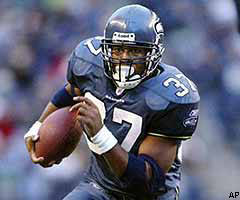
From The Seattle Post - Intelligencer
By DANNY O'NEIL
P-I REPORTER
Shaun Alexander returned to the Seattle area Sunday night, and he's not headed anywhere else for the foreseeable future.
At least not in terms of his football future.
Alexander has agreed to re-sign with the Seattle Seahawks, agreeing to an eight-year contract worth $62 million. In terms of total money in the contract, it is the largest ever signed by a running back; $15 million is to be paid in the first year.
Agent Jim Steiner gave the contract terms to The Associated Press. Sources close to the situation confirmed Alexander's decision to re-sign. The Seahawks had no comment, as the contract had not been completed. A news conference announcing Alexander's return likely will be today at the team's headquarters in Kirkland.
Alexander returned to Seattle on Sunday after attending banquets on the East Coast and Kansas City. He left his cell-phone charger on the East Coast, leaving his phone out of juice.
He could not be reached Sunday evening, but the electricity of his decision was reverberating around the Puget Sound area, as Alexander is returning to the team he helped reach its first Super Bowl last season.
Sunday began with Alexander just hours away from becoming a free agent. Never mind that the start to free agency was eventually delayed as the league's owners and players union continued negotiating an extension to the collective-bargaining agreement. The whole question of free agency is irrelevant when it comes to Alexander.
After a year in which Alexander was asked about his free-agent future at least once a week, he never ended up getting there. It was about the only destination that Alexander didn't reach in a season when he set the league's single-season record for touchdowns, was named NFL MVP and became the franchise's career-leading rusher.
He has 7,817 yards in six years as a Seahawk, a total to which he can now add.
In those six seasons, Alexander has never missed a game, and he has rushed for more than 1,150 yards in each of the five seasons since he supplanted Ricky Watters as the team's starting running back.
In 2004, he finished second in the league in rushing. This season, he won the rushing title with 1,880 yards. He scored 28 touchdowns, breaking Priest Holmes' single-season league record.
Alexander's future was a source of scrutiny since February 2005, when Matt Hasselbeck and Walter Jones signed long-term deals. Alexander got a one-year deal worth $6.32 million as the team's franchise player. Hardly chump change, but security in the NFL is written by long-term contracts -- the kind Alexander will sign this week.
Hasselbeck and Jones remain the highest-paid Seahawks, but in terms of mechanics, the total sum of Alexander's contract surpasses the $60 million deal that LaDainian Tomlinson signed with the San Diego Chargers. However, about $20 million of Tomlinson's deal was guaranteed.
Alexander signed the one-year contract in July, days before training camp, but only after being guaranteed he would be an unrestricted free agent if he didn't work out a contract extension with the Seahawks.
After signing the contract, Alexander was unfailingly optimistic a deal would be worked out, and he never wavered from the expectation he would stay a Seahawk throughout a season in which the contract discussions could be described as polite, but not overwhelmingly productive.
As with so many negotiations, it took a deadline to produce a deal, and Sunday, Alexander took a last look at the possibility of a free-agent future before agreeing to return to Seattle.
Sunday, March 05, 2006
Steelers' Hines Ward travels to mom's homeland, Korea

By ALAN ROBINSON
AP SPORTS WRITER
PITTSBURGH -- Growing up in suburban Atlanta, Hines Ward often felt he was a victim of double discrimination. Not only did some of his white classmates make fun of his biracial heritage, his South Korean mother felt ostracized by her homeland because she had a son with a black American soldier.
Since the Pittsburgh Steelers wide receiver won the Super Bowl MVP award last month, Ward has become a huge celebrity in Korea - cheered by those who know little about American football and once may have shunned him for being less than pureblooded.
To learn more about his heritage, Ward and his mother, Kim Young-hee, plan their first trip together to Korea next month - a country he knows little about and, until recently, knew little about him. Partly because of his recent accomplishments, Ward said Friday he hopes to find a land that may be more receptive to others of mixed blood than it might have been not long ago.
"I'm proud of my mom and proud of our Korean heritage," said Ward, whose name is tattooed in Korean on his right arm. "It's something I should have done a long time ago ... and it's going to be very emotional. And I hope they accept me for who I am."
The 29-year-old Ward, a four-time Pro Bowl receiver and the Steelers' career receiving leader, was born in Seoul but left with his mother and father at age 1 and settled in the United States, where Ward's mom hoped society would be more accepting of the multiracial family.
Ward's parents did not stay together long but, even after they split up, his mother remained in America to be with her son. Despite knowing no English before arriving, she worked as many as three jobs at a time - among them, at an airport, a convenience story and in a school cafeteria - to support her son and give him some of the things his wealthier classmates enjoyed.
At times, he felt embarrassed by their background, but he soon came to appreciate what his mother was doing for him. Now, Ward thinks some of the traits that made him into one of the NFL's top receivers, including a willingness to block with the passion of a lineman while playing a skill position, came from his mother's commitment to hard work.
Even after Ward began making millions in the NFL, his mother returned to her school cafeteria job in Forest Park, Ga., after quitting for a couple of months, saying she felt bored and depressed while not working.
"I want to see where she grew up. I want to see where I was born. I want to see where she played hooky and hung out ... I want to learn more about my heritage," said Ward, who has never returned to Korea since leaving as a toddler, though his mother has gone back 3-4 times. "I want to learn everything."
Ward and his mother planned the weeklong trip before the Super Bowl, where Ward made five catches for 123 yards and a touchdown in a 21-10 Steelers victory over Seattle. But what was supposed to be a "private" trip for Ward devoted to sightseeing, shopping, meeting relatives and eating Korean food has since become a media event.
Ward is expected to meet Korean dignitaries during a trip that begins April 1. He also wants to spend time with some of the children being helped by Pearl S. Buck International, an organization that aids biracial children in Korea.
"When I was there, it wasn't cool to be a mixed kid. There probably was some hatred there," Ward said. "Some of the kids are treated badly and, sadly, it happens, but it's not the kids' fault."
Ward is encouraged because his success has led to considerable media attention in Korea of how society treats those of multiracial backgrounds. A recent editorial in the JoongAng Daily, the country's largest newspaper with a circulation of more than 2 million, cited the praise being heaped on Ward and urged the end to the "embarrassing habit of discrimination against mixed-blood people."
The editorial concluded, "We should open our minds and hold their hands to raise the second and third Hines Ward in Korea."
Ward plans to help fund a scholarship in his mother's name for Korean-American children. He was chosen for a similar scholarship while attending the University of Georgia, even though he was also on an athletic scholarship.
"It's like my mother still tells me, `Always be humble, never forget where you came from,' " Ward said. "My story is kind of a perfect story, of how I was able to overcome all that. Maybe some other kids can use that as motivation."
NFL Labor Negotiations Resume, Deal Close - Wash Post
By Mark Maske
Washington Post Staff Writer
Sunday, March 5, 2006; 12:24 PM
Labor negotiations between representatives of the NFL's team owners and the players' union resumed late this morning in New York amid renewed optimism that a settlement was within reach, a day after the talks had collapsed yet again.
A union official said just before 11:15 a.m. that the bargaining session was about to begin. Gene Upshaw, the executive director of the Players Association, and Richard Berthelsen, the union's general counsel, traveled back to New York from Washington this morning after leaving New York when talks broke down yesterday.
Upshaw said via e-mail early this morning that the parties were "now in the area where we will get a deal. I think it may be there. It comes down to a few final points."
Another participant in the talks said just before today's bargaining session began that any optimism should be tempered, however, because the sides had not yet resumed face-to-face negotiations and there still was plenty of work to be done. He said he was hopeful but less than certain that a settlement was imminent.
It seemed possible that the two sides could agree to a second postponement of the opening of the free-agent market, scheduled for midnight, if they made progress today but could not complete a deal.
Even if the parties emerge from today's negotiations with a tentative agreement, the owners and players would have to ratify the deal. It could be particularly difficult for NFL Commissioner Paul Tagliabue to get a consensus among the owners. The labor deal would have to be ratified by at least 24 of the 32 teams.
If the labor deal is accompanied by an agreement among the owners for clubs to increase the degree to which they share locally generated revenues, it's possible that nine high-revenue teams would band together to block approval of the labor settlement. If the labor deal isn't accompanied by a revenue-sharing accord among the owners, it's possible that nine low-revenue clubs could block it.
Tagliabue had informed the owners they would meet Tuesday in Dallas if there's a labor agreement with the union up for ratification.
The players' executive board is scheduled to meet this week in Hawaii, and the union could put any settlement with owners up for the players' approval then.
The negotiations broke off yesterday with Upshaw saying the owners were unable to compromise, and he left New York and returned to Washington. But the owners were meeting via conference call when Upshaw departed, and league spokesman Greg Aiello said the owners expected negotiations to resume today.
The talks ended yesterday with the owners offering 56.6 percent of an expanded pool of league revenues to the players as compensation under a salary-cap system. Upshaw had dropped his demand that the players receive at least 60 percent, but he would not specify exactly what percentage his latest proposal called for.
Upshaw has maintained that any labor deal between the players and owners would have to be accompanied by an agreement among the owners to increase the degree to which the 32 NFL teams share locally generated revenues. Otherwise, Upshaw has said, lower-revenue clubs could not afford the salary commitment they would be making to the players. Owners have said they could complete a labor deal with the players without finishing a revenue-sharing agreement immediately.
The compromise might be a provision in the labor deal to limit the amount of money that teams can spend above the flexible salary cap. That would address the concerns of lower-revenue teams that the high-revenue clubs could gain a competitive advantage by using their wealth to consistently outspend the salary cap and get better players. The sides had been negotiating about such "cash over cap" before talks broke off yesterday.
The league's free-agent market is scheduled to open at midnight. Teams must be under next season's $94.5 million salary cap by then. If they must release players to get under the cap, they must do so by 6 p.m.
But Upshaw and Tagliabue, facing a similar deadline, agreed Thursday to push back those deadlines by 72 hours, and they could agree to another postponement today if more time is needed to complete the deal or an agreement must be ratified.
The current labor deal keeps the salary-cap system in place through the 2006 season, then there would be a season without a salary cap in 2007 before the deal expires. Tagliabue said Thursday, just after the owners had a 57-minute meeting in New York to officially reject a players' proposal, that the owners had proposed an extension that would run through the 2011 season.
A labor settlement would push next season's salary cap as high as $108 million per team and would alleviate the salary-cap crunches being experienced by many teams.
Washington Post Staff Writer
Sunday, March 5, 2006; 12:24 PM
Labor negotiations between representatives of the NFL's team owners and the players' union resumed late this morning in New York amid renewed optimism that a settlement was within reach, a day after the talks had collapsed yet again.
A union official said just before 11:15 a.m. that the bargaining session was about to begin. Gene Upshaw, the executive director of the Players Association, and Richard Berthelsen, the union's general counsel, traveled back to New York from Washington this morning after leaving New York when talks broke down yesterday.
Upshaw said via e-mail early this morning that the parties were "now in the area where we will get a deal. I think it may be there. It comes down to a few final points."
Another participant in the talks said just before today's bargaining session began that any optimism should be tempered, however, because the sides had not yet resumed face-to-face negotiations and there still was plenty of work to be done. He said he was hopeful but less than certain that a settlement was imminent.
It seemed possible that the two sides could agree to a second postponement of the opening of the free-agent market, scheduled for midnight, if they made progress today but could not complete a deal.
Even if the parties emerge from today's negotiations with a tentative agreement, the owners and players would have to ratify the deal. It could be particularly difficult for NFL Commissioner Paul Tagliabue to get a consensus among the owners. The labor deal would have to be ratified by at least 24 of the 32 teams.
If the labor deal is accompanied by an agreement among the owners for clubs to increase the degree to which they share locally generated revenues, it's possible that nine high-revenue teams would band together to block approval of the labor settlement. If the labor deal isn't accompanied by a revenue-sharing accord among the owners, it's possible that nine low-revenue clubs could block it.
Tagliabue had informed the owners they would meet Tuesday in Dallas if there's a labor agreement with the union up for ratification.
The players' executive board is scheduled to meet this week in Hawaii, and the union could put any settlement with owners up for the players' approval then.
The negotiations broke off yesterday with Upshaw saying the owners were unable to compromise, and he left New York and returned to Washington. But the owners were meeting via conference call when Upshaw departed, and league spokesman Greg Aiello said the owners expected negotiations to resume today.
The talks ended yesterday with the owners offering 56.6 percent of an expanded pool of league revenues to the players as compensation under a salary-cap system. Upshaw had dropped his demand that the players receive at least 60 percent, but he would not specify exactly what percentage his latest proposal called for.
Upshaw has maintained that any labor deal between the players and owners would have to be accompanied by an agreement among the owners to increase the degree to which the 32 NFL teams share locally generated revenues. Otherwise, Upshaw has said, lower-revenue clubs could not afford the salary commitment they would be making to the players. Owners have said they could complete a labor deal with the players without finishing a revenue-sharing agreement immediately.
The compromise might be a provision in the labor deal to limit the amount of money that teams can spend above the flexible salary cap. That would address the concerns of lower-revenue teams that the high-revenue clubs could gain a competitive advantage by using their wealth to consistently outspend the salary cap and get better players. The sides had been negotiating about such "cash over cap" before talks broke off yesterday.
The league's free-agent market is scheduled to open at midnight. Teams must be under next season's $94.5 million salary cap by then. If they must release players to get under the cap, they must do so by 6 p.m.
But Upshaw and Tagliabue, facing a similar deadline, agreed Thursday to push back those deadlines by 72 hours, and they could agree to another postponement today if more time is needed to complete the deal or an agreement must be ratified.
The current labor deal keeps the salary-cap system in place through the 2006 season, then there would be a season without a salary cap in 2007 before the deal expires. Tagliabue said Thursday, just after the owners had a 57-minute meeting in New York to officially reject a players' proposal, that the owners had proposed an extension that would run through the 2011 season.
A labor settlement would push next season's salary cap as high as $108 million per team and would alleviate the salary-cap crunches being experienced by many teams.
Friday, March 03, 2006
Collins and Other NFL Players Safe for Three More Days
The NFL extended the start of the Free Agency period by three days to give teams like the Oakland Raiders time to work out contract problems.
Rumor: Raiders To Release QB Kerry Collins Today
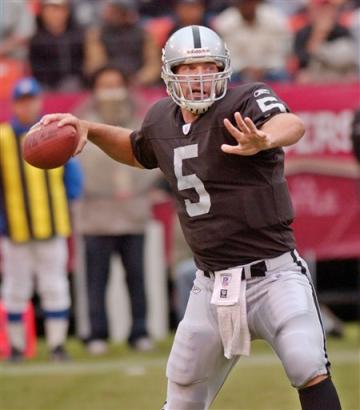
Quarterback Kerry Collins, whose cap value for '06 is $12.898 million, remains with the Raiders but he's expected to be among the cuts later today -- mostly for economic reasons.
The Raiders have until midnight to remove their current $14.8 million excess over the salary cap.
NFL Commissioner Paul Tagliabue Press Conference - Special League Meeting
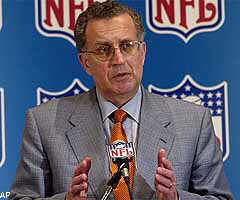
This is from NFL Media.com. The big news to me is that 56 percent was never a number. Where did it come from?
New York Grand Hyatt Regency Hotel
March 2, 2006
Good morning. Obviously we concluded a short but important meeting with our owners. As I think you all know, we came here to explain to them why we're deadlocked with the Players Association. The Players Association has on the table a demand which doesn't recognize the reality of our league's economics today. It's a very excessive and unrealistic demand. So we went through that. The membership endorsed the conclusion that our labor committee -- the eight owners on our Management Council Executive Committee -- had reached when we met with them late yesterday afternoon and last evening. We are indeed deadlocked because of the excessive elements of the Players Association's economic demand and that demand did not provide a basis for any further negotiations. That conclusion of the Management Council Executive Committee was unanimously endorsed by the entire membership. Any questions?
Q: What is the difference between 56 (percent of revenues) and 60 (percent)?
PT: It's not the difference between 56 and 60. I don't know where those numbers come from. It's the fact that, in the last half dozen years, we've created a structure that has enabled us to build an unprecedented number of new stadiums, great stadiums, many of them with very large investments by owners and the league of private resources. Those stadiums, coupled with our TV revenues, have been the engine that has provided prosperity for the players. And the proposal that the Players Association has on the table basically is kind of a "have your cake and eat it, too" proposal. They want to have all the revenues that come out of these facilities and that come out of our growing media rights, but they do not in any way, shape or form recognize the cost to the owners of building those stadiums and investing in all of the things that it takes to generate the revenues. So it's just an untenable economic proposition from the owners' standpoint.
Q: Have you come to terms on what the revenue pool should be and now it's a matter of determining a percentage?
PT: Until you have an agreement, you haven't agreed to anything. We've got sort of tentative understandings that the revenue pool that would go into the salary cap would be certainly much broader than the old DGR concept, but the key thing is that they don't recognize either in the definition of the revenue pool or in their economic proposal the cost structure that goes into generating the revenue.
Q: Is there a fundamental difference in opinion among the owners on revenue sharing?
PT: Nothing could be further away than that (assessment). The revenue sharing issue has never been an impediment in the past to getting an agreement with the Players Association. We've had this agreement in place now with a salary cap and free agency for 13 seasons. I think '06 is the thirteenth season. The revenue sharing issue has never been an impediment, and it's not an impediment now to an agreement with the Players Association. The difference between now and the past is the fundamental change in the way they are defining their expectations as to the percentages that should go to the players and the unwillingness in this proposal, or inability, to recognize the very real costs that are associated with doing all the things the league has done to build new stadiums, generate revenues, invest in a whole range of enterprises that produces the revenue.
Q: What concerns you most about the current situation?
PT: We don't have an agreement and there is a deadline at midnight tonight.
Q: What is the next step from here?
PT: We're going to go back and talk about next steps, but I think at this point, it's not about making phone calls. It's about the Players Association fundamentally changing the character of their proposal and the character of their demands.
Q: How dire a situation is it?
PT: It's about as dire as dire can be. We feel that one of the very positive things about the National Football League since the early '90s has been our Collective Bargaining Agreement, one that works for both sides. We've put a proposal on the table that would extend that through 2011. We recognize that the last year of the current agreement is certainly not ideal in terms of operational realities. Without an extension, it's certainly not a good situation for anybody.
Q: What kind of new rules for free agency will be in place during the uncapped year in 2007?
PT: We don't have any new rules. I think I've basically covered everything that is important today. There has to be a fundamental change in their proposal for anything further of a constructive nature to begin to take place.
Thursday, March 02, 2006
Vince Young and The Wonderlic - Is Profootballtalk.com Making Fun of His Race? Sure Seems So
Hey, I like the information that Profootballtalk.com -- an NFL news website -- issues. Granted, much of it is from the newspapers online, but they do dig and ask questions.
But their cartoons, which appear fresh everyday, seem to take on a racist tone.
At first, I wondered if I was being too sensitive to the matter of race with respect to this cartoon:
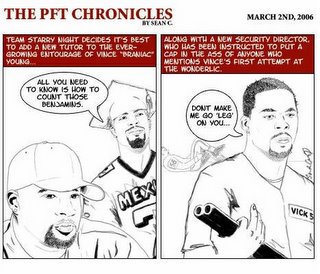
As I walk around the site, the Profootballtalk.com Message Boards ask people not to be racist. So, I give them a pass.
But to test my view, I clicked around the Profootballtalk.com site and found this Al Davis cartoon within seconds:

I think what's up here is a simple case of cultural insentivity. What's the deal with showing a picture -- doctored -- of Al Davis shaking hands with Chef from South Park? Well, they're obviously making fun of the hiring of Art Shell as Raiders Head Coach. But it also seems like a kind of reach back into the past where blacks were made fun of by using cartoons of us with large eyes and super dark skin.
Look, the photo was doctored to depict this image.
I never see Profootballtalk.com lampooning Italians in the mafia, or Irish drunks, so why the focus on blacks?
Just a question -- a good one.
But their cartoons, which appear fresh everyday, seem to take on a racist tone.
At first, I wondered if I was being too sensitive to the matter of race with respect to this cartoon:
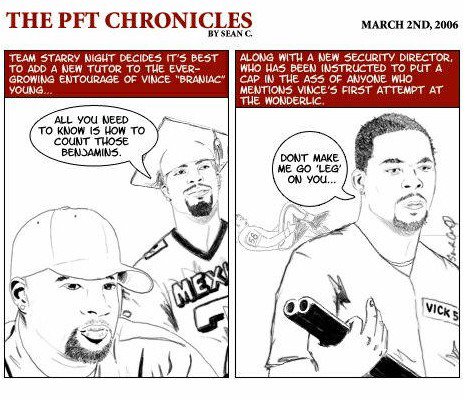
As I walk around the site, the Profootballtalk.com Message Boards ask people not to be racist. So, I give them a pass.
But to test my view, I clicked around the Profootballtalk.com site and found this Al Davis cartoon within seconds:
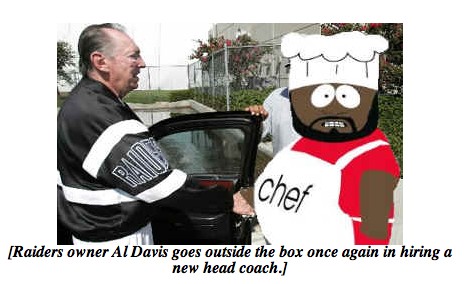
I think what's up here is a simple case of cultural insentivity. What's the deal with showing a picture -- doctored -- of Al Davis shaking hands with Chef from South Park? Well, they're obviously making fun of the hiring of Art Shell as Raiders Head Coach. But it also seems like a kind of reach back into the past where blacks were made fun of by using cartoons of us with large eyes and super dark skin.
Look, the photo was doctored to depict this image.
I never see Profootballtalk.com lampooning Italians in the mafia, or Irish drunks, so why the focus on blacks?
Just a question -- a good one.
Colts over cap; cuts are possible - Indy Star
Colts also signed LB Gary Brackett, who caused the fumble by Jerome Bettis, and the return that nearly won the game for Indy.
Arbitrator's ruling puts team $6 million over limit
By Mike Chappell
mike.chappell@indystar.com
A ruling Wednesday by an NFL arbitrator specifically regarding the contracts of quarterback Peyton Manning and wide receiver Marvin Harrison could result in several significant player cuts by the Indianapolis Colts as they attempt to comply with the league's projected 2006 salary cap of $95 million.
"They're in a tough spot,'' said Mark Levin, director of salary cap and agent administration with the NFL Players Association.
Instead of being sufficiently under the cap so they could re-sign some of their remaining free agents without cutting players under contract, the Colts are $6 million over the cap after the decision by special master Stephen Burbank, a professor at the University of Pennsylvania Law School.
Burbank's decision could be a devastating blow to the Colts' financial planning. That could change, however, if the NFL's owners and players reach an 11th-hour deal to extend the collective bargaining agreement.
At issue, for now, are roster bonuses of $9 million due Manning and $10 million due Harrison. The Colts intended to implement a normal bookkeeping maneuver that converts a roster bonus into a signing bonus and prorating it over the next four years. That would have lowered Manning's '06 cap number from $17.766 million to $10 million and Harrison's cap hit from $14.4 million to $6.9 million.
Suddenly, whether the team can re-sign running back Edgerrin James, one of 11 players who will become an unrestricted free agent Friday, might be the least of its worries. If Manning and Harrison count a combined $32 million against the cap, the Colts probably will have to jettison several players.
In the current climate, owner Jim Irsay said "it's going to be very difficult to keep Edgerrin and probably difficult to keep (starting linebacker) David Thornton."
Complicating every team's attempt at dealing with their rosters and the salary cap is the lack of a new collective bargaining agreement. Negotiations broke down Tuesday in New York. Barring a last-minute resolution, the new league year will open Friday without an extension.
An extension likely would include a higher salary cap, topping $100 million, which could help alleviate the Colts' cap problem.
The lack of an extension carries restrictive guidelines regarding player contracts, including the conversion of roster bonuses. According to NFL spokesman Greg Aiello, Burbank ruled such conversions are prohibited under the labor agreement if they violate the so-called "30 percent rule,'' which keeps base salaries from increasing more than 30 percent each year over the first year of the contract.
The special master is an arbitrator provided by the labor agreement and approved by both the owners and players.
It's believed a special master's ruling is final, but Irsay said the issue is far from resolved.
"We'll know more in a week or so,'' he said. ". . . If there are any disagreements internally on contract language, I feel we'll be OK there. Whether there will be an extended dispute with any of our guys remains to be seen. We feel that we're going to prevail and that we're in good shape.''
Arbitrator's ruling puts team $6 million over limit
By Mike Chappell
mike.chappell@indystar.com
A ruling Wednesday by an NFL arbitrator specifically regarding the contracts of quarterback Peyton Manning and wide receiver Marvin Harrison could result in several significant player cuts by the Indianapolis Colts as they attempt to comply with the league's projected 2006 salary cap of $95 million.
"They're in a tough spot,'' said Mark Levin, director of salary cap and agent administration with the NFL Players Association.
Instead of being sufficiently under the cap so they could re-sign some of their remaining free agents without cutting players under contract, the Colts are $6 million over the cap after the decision by special master Stephen Burbank, a professor at the University of Pennsylvania Law School.
Burbank's decision could be a devastating blow to the Colts' financial planning. That could change, however, if the NFL's owners and players reach an 11th-hour deal to extend the collective bargaining agreement.
At issue, for now, are roster bonuses of $9 million due Manning and $10 million due Harrison. The Colts intended to implement a normal bookkeeping maneuver that converts a roster bonus into a signing bonus and prorating it over the next four years. That would have lowered Manning's '06 cap number from $17.766 million to $10 million and Harrison's cap hit from $14.4 million to $6.9 million.
Suddenly, whether the team can re-sign running back Edgerrin James, one of 11 players who will become an unrestricted free agent Friday, might be the least of its worries. If Manning and Harrison count a combined $32 million against the cap, the Colts probably will have to jettison several players.
In the current climate, owner Jim Irsay said "it's going to be very difficult to keep Edgerrin and probably difficult to keep (starting linebacker) David Thornton."
Complicating every team's attempt at dealing with their rosters and the salary cap is the lack of a new collective bargaining agreement. Negotiations broke down Tuesday in New York. Barring a last-minute resolution, the new league year will open Friday without an extension.
An extension likely would include a higher salary cap, topping $100 million, which could help alleviate the Colts' cap problem.
The lack of an extension carries restrictive guidelines regarding player contracts, including the conversion of roster bonuses. According to NFL spokesman Greg Aiello, Burbank ruled such conversions are prohibited under the labor agreement if they violate the so-called "30 percent rule,'' which keeps base salaries from increasing more than 30 percent each year over the first year of the contract.
The special master is an arbitrator provided by the labor agreement and approved by both the owners and players.
It's believed a special master's ruling is final, but Irsay said the issue is far from resolved.
"We'll know more in a week or so,'' he said. ". . . If there are any disagreements internally on contract language, I feel we'll be OK there. Whether there will be an extended dispute with any of our guys remains to be seen. We feel that we're going to prevail and that we're in good shape.''
Monday, February 27, 2006
Vince Young and The Wonderlic Test: What Does the Test Really Prove? That America's Still Racist - Dan Marino Scored a 16
There has been much press about Texas QB Vince Young scoring only six of 50 questions correct on something called The Wonderlic Test, and that the test was incorrectly scored. Aside from the character assasination that has taken place against Young, and by some who don't want to see him succeed and are acting in a boarderline illegal and prosecutable fashion, I doubt the Wonderlic itself is being used properly. It's supposed to test an employees ability to solve problems related to a job.
I'm going to throw this bomb: The Wonderlic Test -- as it's applied -- has nothing to do with football and given the fact that the questions aren't directly related to the game, an athlete could sue an NFL team or the NFL itself for damages related to the improper use of the test.
I'm not kidding.
According to legal scholar Daniel L. Wong, the case of Griggs v. Duke Power Co., 401 U.S. 424 considered and invalidated the use of the "Wonderlic Personnel Test," which purported to measure general intelligence, and the Bennett Mechanical Comprehension Test.
Albemarle Paper Co. v. Moody, 422 U.S. 405, 431 (1975) also considered the Wonderlic test as well as the Beta Examination, which purported to test non-verbal intelligence. The key in these and subsequent federal decisions, is the extent to which employers are able to demonstrate that tests are truly related to job performance.
Jason Chung wrote an 18-page paper reporting in part how the Wonderlic is used as a way to block the assention of black college quarterbacks into the NFL. Chung writes:
The "Wonderlic" Argumentation
Another major barrier that African-American quarterbacks face stems from the increased use of the Wonderlic intelligence test through 1968 to 1999. Michael Callans, President of Wonderlic Consulting, advances the popular argument that:
[Quarterbacks] need to lead, think on their feet, evaluate all of their
options and understand the impact their actions will have on the
outcome of the game. Wonderlic helps team owners make the best
selections by identifying which players have the mental strength to
lead their team to victory.
This belief has been prevalent since at least the 1970s when Tom Landry of the Dallas Cowboys became the first NFL head coach to screen for players using a generic aptitude test - the Wonderlic Personnel Test.25 Landry was looking for a tool to quantify intelligence and draw a correlation between that and performance. In the subsequent 30 years upon its introduction the Wonderlic has become a key performance prognosticator for many NFL franchises. Though most prospective NFL players are put through the test, those players in strategic (read white) positions are scrutinized more closely. NFL scouts believe that the test will help them identify quarterbacks that will assimilate NFL playbooks quicker and identify quarterbacks that make better decisions.
Generally speaking, a score in the mid-twenties is considered acceptable for a prospective NFL quarterback. In 1994, the Cleveland Browns were looking for a quarterback that scored at least a 24 on the Wonderlic. These high expectations have acted as an imposing intellect barrier for African-American quarterbacks who, as an ethnic group, have historically had a tough time meeting this benchmark and thus were discounted from consideration by some NFL teams due to a deficiency of intellect. There were but few black quarterbacks, the argument went, that had the mental capacity to succeed on the test and therefore on the field. An examination of relatively reliable Wonderlic scores shows that black quarterbacks, more commonly than white quarterbacks, score lower than 20: Jeff Blake in 1992, Kordell Stewart in 1995 and Steve McNair in 1995 all scored 17 or lower.
The failure of African-American quarterbacks to meet the lofty mid-twenties standard has spawned criticism of the whole procedure. The traditional argument against the Wonderlic has been that it, like all aptitude tests, was culturally biased and therefore systemically set up to ensure that black athletes receive lower scores. This charge, until recently, was the primary accusation levelled against the Wonderlic.
However, more recent studies have exposed a more illuminating fact. A study by David Chan et al. noted that African-Americans adults in general have a lower regard in general for aptitude tests than their Caucasian counterparts which caused them to score lower on the tests. After motivation was given to black test-takers their scores improved until there was no
discernible difference between black test scores and white test scores.
Critics point to additional flaws with the Wonderlic system other than race-related lower test scores. It has been pointed out that there are some "Wonderlic smart" players that are "football dumb". Numerous NFL coaches, including Tony Dungy and Denny Green, note that good Wonderlic scores do not necessarily equate success in decision-making prowess on the
field.
Indeed, the converse is also true, low Wonderlic scores do not necessarily signify weak quarterback play. For instance, Dan Marino, the NFL's all-time leading passer, only scored a 16 but by all accounts he was very intelligent football-wise.
Still, because it remains the only quantifiable method of measuring intelligence the Wonderlic continues to be used by NFL teams. As a consequence, because of the reasons stated above, it seems black quarterbacks will generally continue to score lower on the Wonderlic than their white counterparts. If the period from 1968 to 1999 is any indication, many black quarterbacks will be shunned due to a low score and "low intelligence".
That is what's happening today. But since it's true that the Wonderlic does not actually measure football related aptitude, then the NFL itself is wide open for a class action lawsuit if this problem is not cleared up -- a legal battle the league would surely lose.
It would lose on the very basis that its own coaches can't defend the claim that it tests "football intelligence" yet that's the image being communicated by much of the media and some NFL teams. If a player scores poorly on it, they, like Vince Young, are branded as not football smart, an observation anyone would have to be a total fool to accept in the case of Texas' National Champion QB.
And with that, someone must explain how Miami's NFL Hall of Fame Quarterback Dan Marino -- who scored a 16 on the Wonderlic -- became one of the league's best signal callers in its history? A 16 on the Wonderlic means that Marino had an IQ of less than 100. Do you believe that? I didn't think so.
Someone out there better appologize to Vince Young.
I'm going to throw this bomb: The Wonderlic Test -- as it's applied -- has nothing to do with football and given the fact that the questions aren't directly related to the game, an athlete could sue an NFL team or the NFL itself for damages related to the improper use of the test.
I'm not kidding.
According to legal scholar Daniel L. Wong, the case of Griggs v. Duke Power Co., 401 U.S. 424 considered and invalidated the use of the "Wonderlic Personnel Test," which purported to measure general intelligence, and the Bennett Mechanical Comprehension Test.
Albemarle Paper Co. v. Moody, 422 U.S. 405, 431 (1975) also considered the Wonderlic test as well as the Beta Examination, which purported to test non-verbal intelligence. The key in these and subsequent federal decisions, is the extent to which employers are able to demonstrate that tests are truly related to job performance.
Jason Chung wrote an 18-page paper reporting in part how the Wonderlic is used as a way to block the assention of black college quarterbacks into the NFL. Chung writes:
The "Wonderlic" Argumentation
Another major barrier that African-American quarterbacks face stems from the increased use of the Wonderlic intelligence test through 1968 to 1999. Michael Callans, President of Wonderlic Consulting, advances the popular argument that:
[Quarterbacks] need to lead, think on their feet, evaluate all of their
options and understand the impact their actions will have on the
outcome of the game. Wonderlic helps team owners make the best
selections by identifying which players have the mental strength to
lead their team to victory.
This belief has been prevalent since at least the 1970s when Tom Landry of the Dallas Cowboys became the first NFL head coach to screen for players using a generic aptitude test - the Wonderlic Personnel Test.25 Landry was looking for a tool to quantify intelligence and draw a correlation between that and performance. In the subsequent 30 years upon its introduction the Wonderlic has become a key performance prognosticator for many NFL franchises. Though most prospective NFL players are put through the test, those players in strategic (read white) positions are scrutinized more closely. NFL scouts believe that the test will help them identify quarterbacks that will assimilate NFL playbooks quicker and identify quarterbacks that make better decisions.
Generally speaking, a score in the mid-twenties is considered acceptable for a prospective NFL quarterback. In 1994, the Cleveland Browns were looking for a quarterback that scored at least a 24 on the Wonderlic. These high expectations have acted as an imposing intellect barrier for African-American quarterbacks who, as an ethnic group, have historically had a tough time meeting this benchmark and thus were discounted from consideration by some NFL teams due to a deficiency of intellect. There were but few black quarterbacks, the argument went, that had the mental capacity to succeed on the test and therefore on the field. An examination of relatively reliable Wonderlic scores shows that black quarterbacks, more commonly than white quarterbacks, score lower than 20: Jeff Blake in 1992, Kordell Stewart in 1995 and Steve McNair in 1995 all scored 17 or lower.
The failure of African-American quarterbacks to meet the lofty mid-twenties standard has spawned criticism of the whole procedure. The traditional argument against the Wonderlic has been that it, like all aptitude tests, was culturally biased and therefore systemically set up to ensure that black athletes receive lower scores. This charge, until recently, was the primary accusation levelled against the Wonderlic.
However, more recent studies have exposed a more illuminating fact. A study by David Chan et al. noted that African-Americans adults in general have a lower regard in general for aptitude tests than their Caucasian counterparts which caused them to score lower on the tests. After motivation was given to black test-takers their scores improved until there was no
discernible difference between black test scores and white test scores.
Critics point to additional flaws with the Wonderlic system other than race-related lower test scores. It has been pointed out that there are some "Wonderlic smart" players that are "football dumb". Numerous NFL coaches, including Tony Dungy and Denny Green, note that good Wonderlic scores do not necessarily equate success in decision-making prowess on the
field.
Indeed, the converse is also true, low Wonderlic scores do not necessarily signify weak quarterback play. For instance, Dan Marino, the NFL's all-time leading passer, only scored a 16 but by all accounts he was very intelligent football-wise.
Still, because it remains the only quantifiable method of measuring intelligence the Wonderlic continues to be used by NFL teams. As a consequence, because of the reasons stated above, it seems black quarterbacks will generally continue to score lower on the Wonderlic than their white counterparts. If the period from 1968 to 1999 is any indication, many black quarterbacks will be shunned due to a low score and "low intelligence".
That is what's happening today. But since it's true that the Wonderlic does not actually measure football related aptitude, then the NFL itself is wide open for a class action lawsuit if this problem is not cleared up -- a legal battle the league would surely lose.
It would lose on the very basis that its own coaches can't defend the claim that it tests "football intelligence" yet that's the image being communicated by much of the media and some NFL teams. If a player scores poorly on it, they, like Vince Young, are branded as not football smart, an observation anyone would have to be a total fool to accept in the case of Texas' National Champion QB.
And with that, someone must explain how Miami's NFL Hall of Fame Quarterback Dan Marino -- who scored a 16 on the Wonderlic -- became one of the league's best signal callers in its history? A 16 on the Wonderlic means that Marino had an IQ of less than 100. Do you believe that? I didn't think so.
Someone out there better appologize to Vince Young.


